

Days 11–13, Part 2: Into Tuscany
- Edward Leung
- Apr 16
- 7 min read

Updated: Apr 19
37 Days Across Europe · Days 11–13 of 37 · Siena · San Gimignano · Pisa
A day out of Florence. Siena's medieval gravity, San Gimignano's towers, a wine lunch somewhere in between — and the obligatory lean.
SIENNA

There is a version of the Tuscany day trip that a lot of travellers do from Florence. They book a coach, see Siena at speed, cross San Gimignano off the list, and are back in Florence by dinner. I understand this. Thought I would never do that but what the hell, was too lazy to drive.
Siena was inconvenient and without "Get Your Guide" it would have been a nightmare to navigate myself. It turned out to be one of the better decisions of the Italian leg. Tuscany is one of those landscapes that rewards the ability to stop, if only if I could pull over on a hillside road or take the long way through a village that wasn't part of the tour. Alas I could only do this from a coach window.
Nevertheless we left Florence early. By the time we reached Siena, the morning mist was still sitting in the valleys and the city was quiet.
The City That Florence Could Have Been
Florence and Siena are separated by roughly 70 kilometres and somewhere between five hundred years of rivalry and a completely different idea of what a city should be. Florence won, historically speaking — it absorbed Siena in 1555 — but Siena responded to this by essentially stopping, by preserving its medieval self with an almost defiant completeness. The result is a city that feels less like a living place and more like the most extraordinary stage set ever constructed. Which sounds like a criticism and isn't.

The Piazza del Campo is the thing everyone comes for, and it earns every superlative. The shell-shaped concave brick floor, the Palazzo Pubblico with its tower, the way the surrounding buildings curve around the space in a half-ring, it is the greatest medieval piazza in Italy, possibly in Europe, and the only appropriate response on first sight is to stand still and let it register. Which is what I did, at some length, despite the overcast sky and the delivery van parked at the far edge that nobody seemed bothered by.


What the photographs don't show, what they can't, is the quality of Siena's silence. Florence is noisy even when it's quiet. Siena, even at midday with tourists in the piazza, has a stillness to it that comes from the stone itself, from streets so narrow that sound doesn't travel far, from a city that has been sealed inside its medieval walls for five centuries and hasn't particularly wanted to modernise beyond them.

The Duomo Interior: A Room You Are Unprepared For
I will say something about the Siena Duomo that I was not expecting to say, having arrived already saturated with Italian cathedral interiors from Florence. It is unlike anything else.
The striped black and white marble, every column, every wall surface, rising from floor to dome, creates an effect that feels less like a church and more like a fever dream of geometry. The floor alone contains 56 marble inlaid panels, each one a different scene, each one covered for most of the year to protect it. The altarpiece blazes gold against that monochrome striping. The round window sends a circle of light down the nave that moves with the hours like a clock.


"Siena makes no effort to seem relevant. It simply is what it was, sealed inside its walls, indifferent to the century outside them. And somehow this is the most contemporary thing about it."
The best of Siena is found once you leave the Campo and begin walking the smaller streets that radiate outward through the city's seventeen medieval districts. Every alley gives onto something, an arch, a church facade, a sudden view over the Tuscan hills visible at the end of a narrow gap between buildings.
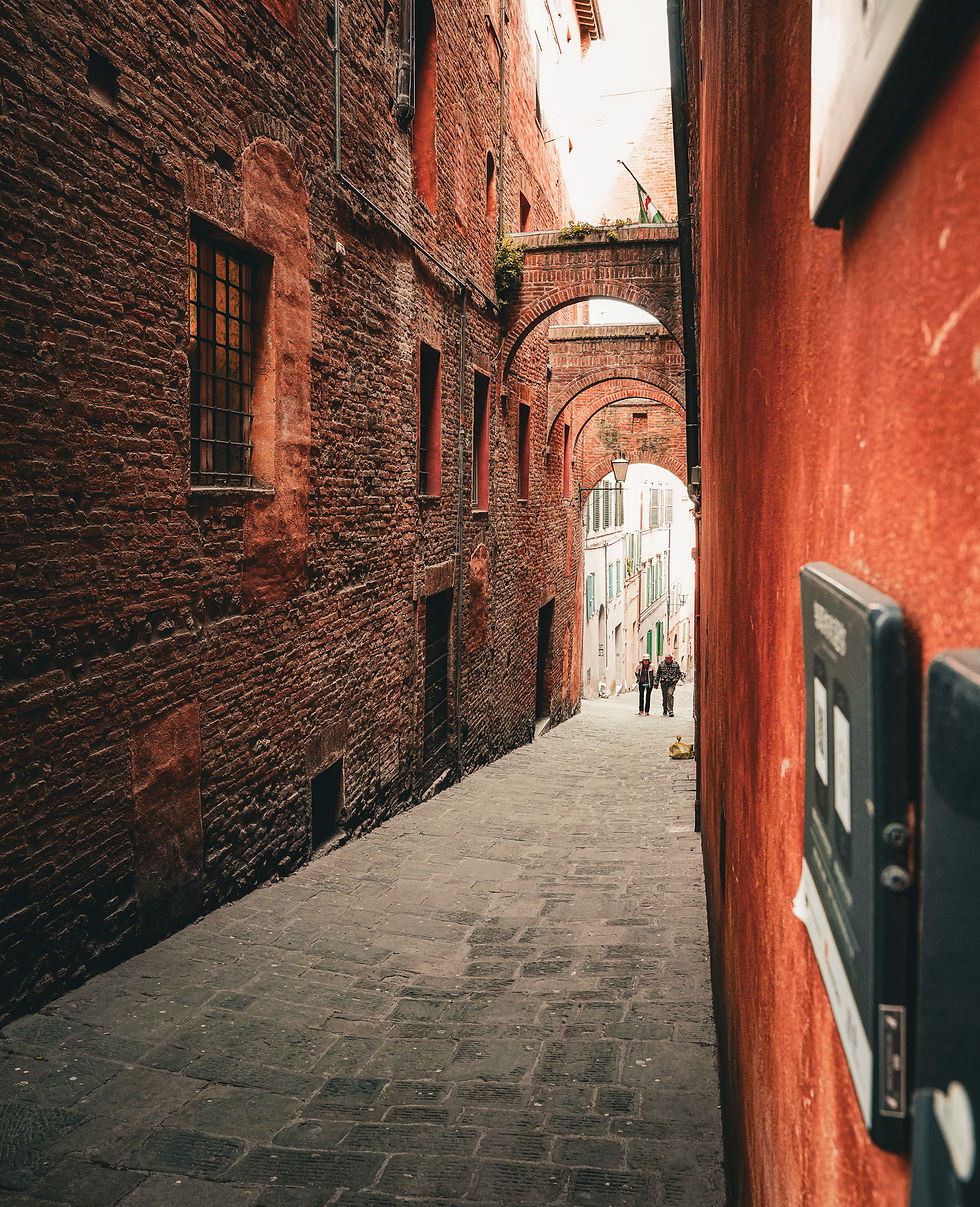


Two versions of the same wall, before and after — and a Sienese alley that somehow manages to be both entirely ordinary and completely cinematic simultaneously.
San Gimignano: The Medieval Manhattan
An hour northwest of Siena, San Gimignano sits on its hilltop like a medieval city that forgot to grow up. Fourteen towers still stand — the remnants of a once-72-strong skyline built by competing noble families as expressions of wealth and power, each family trying to build higher than their neighbours. The result, from a distance, looks genuinely improbable. From inside the walls, it looks like a film set, which is either a problem or a feature depending on your relationship with photogenic places.


We stopped for lunch somewhere between San Gimignano and the road south, a winery of sorts, Chianti was the order of the day. It was kind of unfortunate that I did not finish the wines on offer but it was getting late and I was already "south of the border" hence we moved on.with the afternoon softened agreeably around the edges.
This is, I should note, the correct way to visit Tuscany if you have the time, hire a car and perhaps a designated driver. In my case a tour bus did help.
Pisa: Let's Be Honest About It
I want to be fair to Pisa, because the city itself is genuinely pleasant, a university town with a good river, decent food, and a character entirely separate from its most famous attraction. The problem is that almost nobody who visits Pisa sees any of this, because the Leaning Tower is so comprehensively the reason for coming that everything else becomes invisible by comparison, including the cheesy pictures.


The tower itself: yes. You should see it. It leans more than you expect and the effect in person produces a genuine moment of disorientation that no photograph captures, your eye expects vertical and the tower refuses it. This architectural wrongness, a structural failure that became the world's most famous building, is oddly moving when you stand in front of it. An engineering mistake that outlasted every intentional achievement of its era.
The Campo dei Miracoli — the cathedral, the baptistery, the tower, on their shared green lawn, is beautiful in a way that surprises. You arrive expecting a tourist trap and find instead something quietly magnificent, the white marble catching whatever light is available and doing something luminous with it, the proportions generous in a way that the photographs don't suggest.
Would I make a special journey to Pisa? No, not quite. Would I add it to a Tuscan day that's already taking in Siena and San Gimignano? Without hesitation. Three hours is enough. See the piazza, eat a sandwich, get back on the road. And resist the impulse to photograph yourself holding up the tower. You will thank yourself for this later.
Coming next — Part 3
The Last Day in Florence
A simple walkabout. No agenda. The accordion player, the accordion player's wall, the last espresso, a wine window or two. Then the train north, and France.


Comments