top of page

37 Days Across Europe · Days 18–24 Paris, France

  • Writer: Edward Leung
    Edward Leung
  • May 16
  • 15 min read

Updated: 6 days ago

Seven nights in Paris. Montmartre as base. One day trip to Normandy and a painter's garden. And the slow, dawning realisation that Paris is the kind of city that makes you feel you've done it no matter how little of it you've actually seen, and then quietly makes you wish you'd stayed longer.


37 Days Across Europe · Days 18–24 of 37 · Paris, France

White domed basilica under clear sky, surrounded by trees. People sit on steps, enjoying the sunny day. Black and white image.
Sacré-Cœur from the base of the Butte, black and white. The carousel in the foreground — all gilded horses and faded paint — the basilica rising white behind it, the steps covered. The sky rendered deep and absolute in monochrome. This is the Montmartre that Paris sells. It happens to be accurate.

We arrived from Rome by AirFrance, France's national carrier. Not too shabby I must say and pleasantly surprised by the service quality and comfort. Despite the reports of chaos at the airports, yes the announce implementation of the ETIAS, it did not impact those travelling within Schengen countries. Just don't be alarmed by the frantic running and reaction of those exiting to outside those countries (mental note!!).


Paris does not ease you in. Rome is chaotic on impact. Florence is immediately, completely itself. Paris makes you feel, for the first twenty minutes, like you've stumbled into the background of someone else's film. Then it clicks.


Seven nights. More than anywhere else on this trip, and still not enough. That is Paris's position, and it will not be negotiated.


We stayed in Montmartre. The 18th arrondissement. Home to the Moulin Rouge, to Sacré-Cœur, to the artist studios that made the neighbourhood's reputation, and to a density of neighbourhood life that the guidebooks undersell considerably. It is, without question, the right base (many thanks to my crafty daughter, more on that when I later post on food that I have had during this trip, including a 1 Michelin star meal).


Man in sunglasses plays accordion joyfully on a street, seated by a fence with locks. Dappled sunlight, green backdrop, cap on ground.
The accordion player, Montmartre. A man with a Hohner and a hat, seated on a stool in front of the love-lock fence, grinning at no one in particular. His collection cap sits upturned on the pavement in front of him. He is not performing for you. He is performing for the neighbourhood, which happens to be the same thing.

Montmartre has a reputation as tourist territory, and it is not wrong. The approaches to Sacré-Cœur are busy, sometimes exhaustingly so. The square at the top, Place du Tertre, operates as a functioning portrait-artist colony at controlled fever pitch from morning to night. The streets leading up from Abbesses metro are full of people doing exactly what you are doing.

Nevertheless, just one or two streets away, the legendary Montmartre comes alive again: steep cobblestone paths, shuttered windows adorned with flower boxes, and locals who haven't altered their pace despite being surrounded by tourists for years. It's a place best explored without a plan. Be sure to watch for one of the staircases that lead up to the Sacre-Coeur, as this is where the fight scene in John Wick 4 was filmed.


A majestic stone cathedral with domes under a clear blue sky, framed by tree branches. A cobblestone plaza lies in the foreground.
Sacré-Cœur from the cobblestone forecourt, colour. The warm stone of the basilica in sharp morning light, the equestrian statue of Joan of Arc in the foreground. The blue sky is almost unreasonably cooperative. This is the side of Sacré-Cœur that photographs do not usually show — not the grand frontal view from the steps, but the quieter approach from Rue Azaïs.

The basilica itself is Romano-Byzantine in style, which is a polite way of saying it looks like nothing else in Paris and feels like nothing else in France. Completed in 1914, consecrated after the First World War, it has been a perpetual-adoration site since 1885, meaning that prayer has been uninterrupted inside for well over a century. It is a working basilica, not a tourist attraction with occasional services. Worth holding that in mind when you enter.


Stone cathedral with horse statues in front and clear blue sky. A street sign reads "Rue Azaïs." Warm lighting creates a peaceful mood.
Rue Azaïs. The green enamel street sign in the foreground, the turrets and equestrian figures of Sacré-Cœur visible just around the corner, the warm stone of the wall filling half the frame. Stickers from various Parisian crews decorate the corner alongside the philosopher's dates: 1766–1845.

One of the things that Montmartre does particularly well is the collision of registers. A philosopher's name on a street sign, overlaid with stickers. Joan of Arc in bronze, with a bus stop beside her.


This is not a neighbourhood that has preserved itself in amber. It is still functioning, still accumulating, still scrawling over its own history while the tourists photograph the results.


Market scene with people walking on a sunny cobblestone street. Colorful hats displayed outside shops. Sign reads "GALERIES DES TISSUS."
The Galeries des Tissus, Montmartre. The cobblestone street at mid-morning, the stalls full, the crowd thick — hats, jerseys, the full apparatus of street commerce. This is the Montmartre that the tourist brochures don't photograph, because it looks exactly like every other busy market street in every city. It is, accordingly, completely real.

Getting around Paris was easier than I expected. The metro is excellent, comprehensive, frequent, mostly legible once you've spent twenty minutes with the map. The practical move: download the Navigo app and add it directly to your Apple Wallet. It is seamless and requires no queuing at a machine. We bought the ten-ticket carnet option, which suited our pace well enough. If you're planning to move across the city multiple times a day, the unlimited pass is worth the arithmetic. Do your research before you land. The Instagram account @lefrenchies is genuinely useful, local knowledge, practical advice, none of the breathlessness of mainstream travel content.


Woman walks past outdoor café on a cobblestone street. Café has red awning with "Au Soleil de la Butte." Warm afternoon light.
Au Soleil de la Butte, Montmartre. The red awning, the full terrace, the cobblestones, a woman in black crossing mid-frame with the studied indifference of someone who has places to be. The Brasserie sign glows orange beside it. This is the Paris that people come here to find. The good news: it exists.

The Café Corner. The Wine. The Afternoon.

Paris taught me something I should have already known about European cities: the ones that have been the subject of the most photography are not necessarily diminished by that fact.

You turn a corner in Montmartre and the red-awning café corner is simply there, exactly as advertised, and it is still beautiful. Familiarity and beauty are not in competition here. They coexist as a matter of municipal policy.


Wine bottle and glass on a metallic table, with "Famille Descombe Pinot Noir" label. Red chairs and a menu in a cozy restaurant setting.
Famille Descombe Pinot Noir. A glass poured, the bottle behind it, the orange bistro chairs soft in the background. A pause, somewhere in the middle of the afternoon. Between Sacré-Cœur and everything else.


I will note for the record that the wine was very good.


Vintage cafe exterior with graffiti, menu boards, red chairs, and a chess set on tables. Warm, eclectic vibe with stacked books.
Le Coin du Moulin, Montmartre. The black facade, the graffiti tags, a portrait of Frida Kahlo. A chalkboard listing Aperol Spritz and Negroni alongside milkshakes in five flavours. Red velvet chairs out on the cobblestones, a chess table mid-game. This is a Montmartre institution doing exactly what Montmartre institutions do: being loudly, chaotically, completely themselves.

The Neighbourhood After Dark


The neighbourhood's bohemian reputation is not historical myth. It is present tense. The bars and cafés around the upper streets of the 18th still operate with a kind of performative independence that you don't find in the more polished arrondissements. Le Coin du Moulin, with its chess tables and its milkshakes and its political slogans, is not unusual here. It is fairly representative.
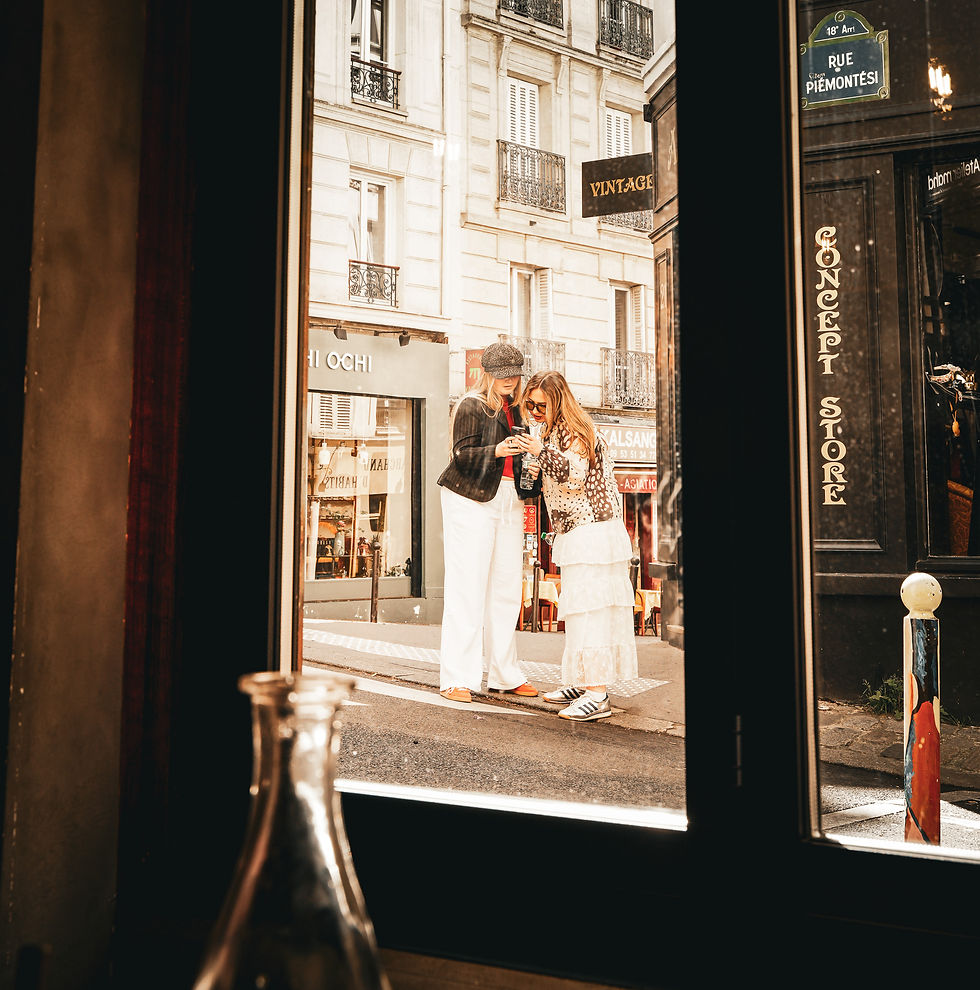

Two women in stylish outfits look at a phone together on a city street. They're viewed through a café window, with a sign reading "CONCEPT STORE."
Shot from inside a café on Rue Piémontési, through the open window, two women consulting a phone on the pavement. A glass bottle in the foreground, slightly out of focus. A completely ordinary scene, which is why it works.
Woman in sunglasses leans against a cream-colored wall beside a red door numbered 3. Cobblestone street and ornate railing above.
No. 3, somewhere in Montmartre. A deep red door. My daughter, in black leather jacket, hands in pockets, leaning against the frame with the calm of someone who has spent the last three weeks walking across Europe. She looked like she belonged.


A person in black points at photos on a graffiti-covered wall. Street sign reads "Rue André Antoine." Mural of a girl sewing Earth, text "Please Smile."
Rue André Antoine, 18th arrondissement. My better half examining a cluster of photographs pinned to a corner wall above a large paste-up mural: a girl in a green dress with a first-aid kit, "Please Smile" stencilled beside her. Montmartre as open-air gallery.

Street Art, Slow Streets, and the City at Its Own Pace


Montmartre is full of this. The street art is not concentrated in specific zones, it is woven into the fabric of the neighbourhood, on walls and shutters and cornices and drain pipes. Some of it is world-class. Some of it is tagging. The line between the two is not always where you'd expect.
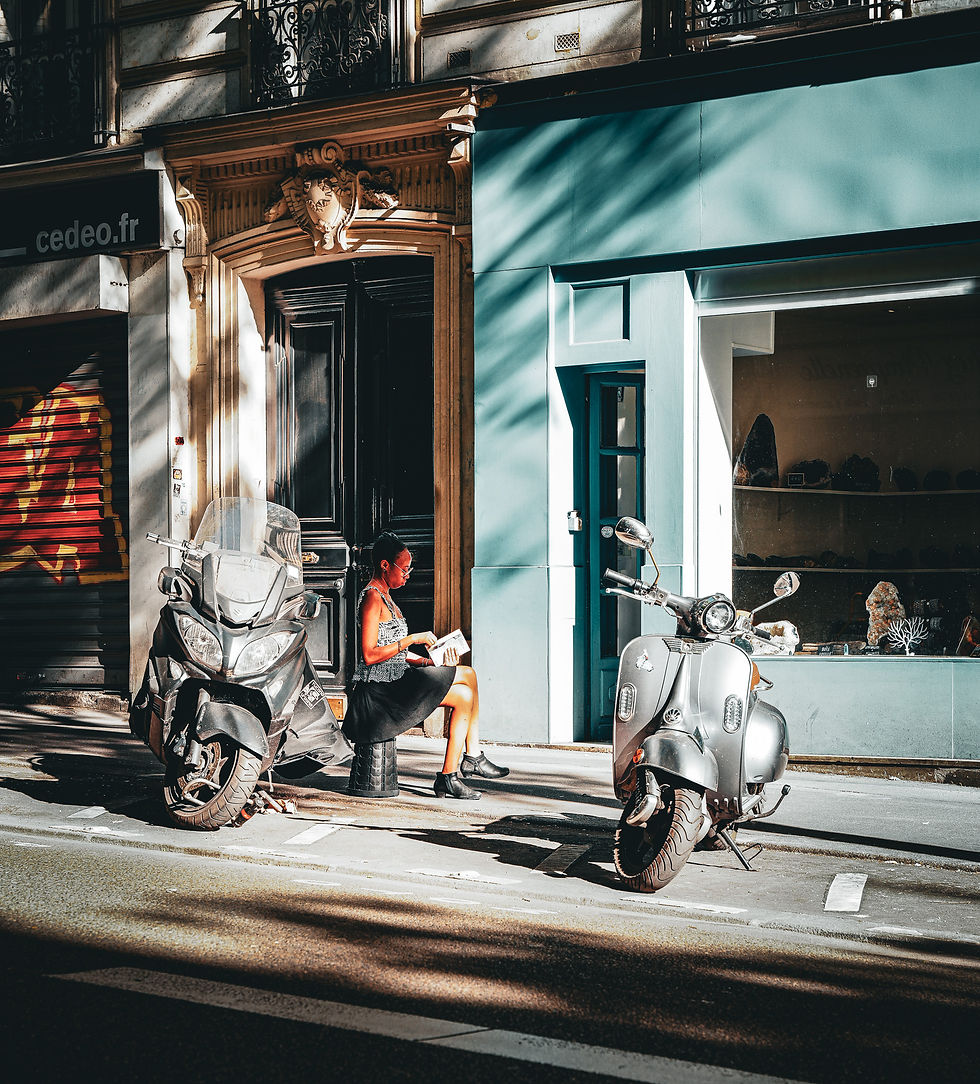

Woman sitting on a stool reads a magazine between two parked scooters on a sunlit street. Blue building facade in the background.
A quiet street off the main drag. A woman seated on a bollard between a large touring motorcycle and a silver Vespa, reading a book — completely unbothered. The teal shopfront beside her, its window full of amethysts and white coral. Paris does not ask your permission before composing itself.
Woman walks past a store with blue doors on a city street. Bicycle is parked nearby. Building has two windows with flower boxes.
A woman in a cream jacket and wide-leg jeans, phone to her ear, mid-stride past a deep cobalt blue door — No. 16. A cargo bike at the kerb. Through the glass behind her, the warm amber light of what appears to be a gallery. Paris, doing its thing.


Cyclist in orange rides past a pink boutique, Antoine & Lili, with mannequins in colorful outfits displayed in the windows on a sunny day.
Antoine & Lili. The pink facade, mannequins in the windows, and a cyclist in an orange jacket blurred in the foreground. Still versus moving. Colour against colour.
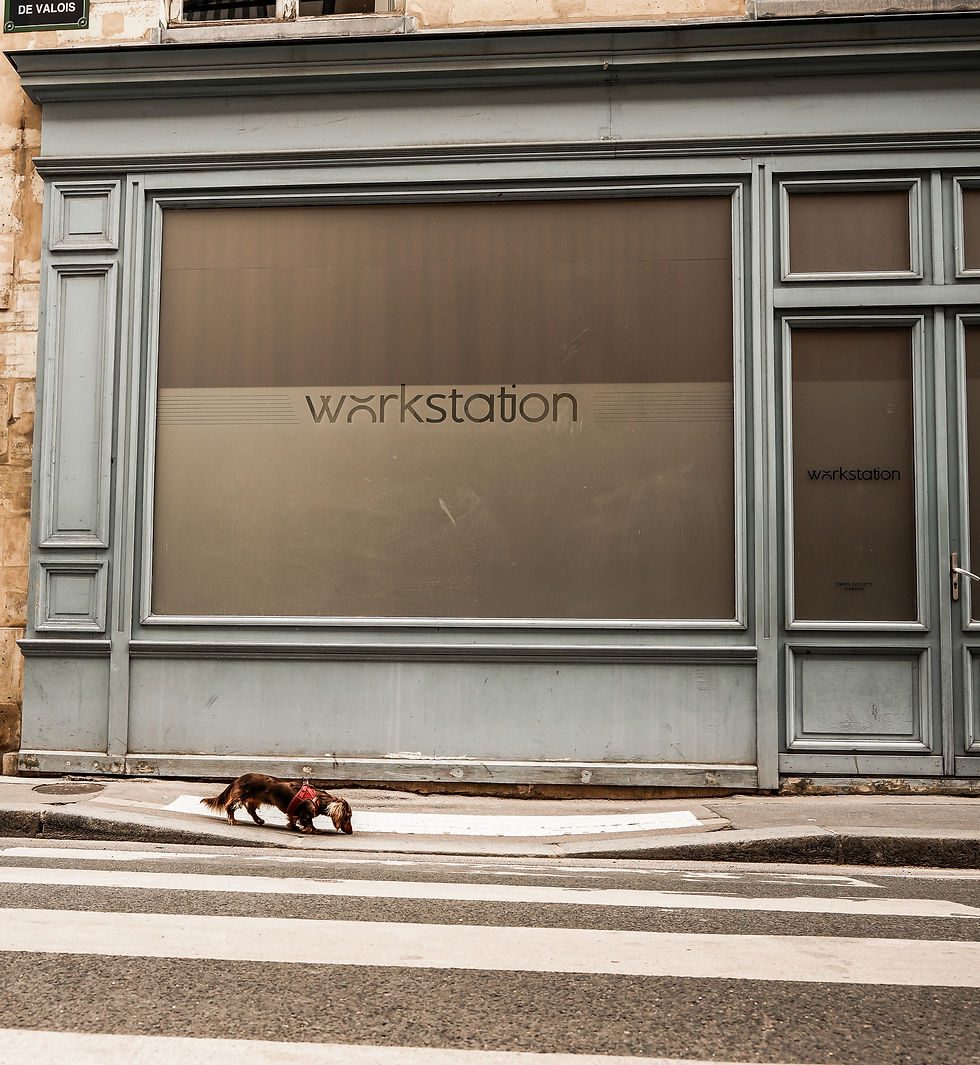
Dog in a red harness sniffing a sidewalk by a gray building with large windows labeled "workstation." Crosswalk and muted tones.
Rue de Valois. A long-haired dachshund in a red harness, sniffing the pavement in front of a Workstation shopfront. The dog is completely unbothered by the scale of its surroundings. This is a quality I respect.


Paris has a dog problem, by which I mean Paris has an enormous number of dogs and has arranged its entire civic and commercial infrastructure around their comfort and convenience, and I found this admirable.


You will find dogs in cafés, on the metro, in shops, on the steps of churches. They are citizens here in a way that feels formally acknowledged.


Serene garden scene with tall trees reflecting in a pond, surrounded by white tulips under a clear blue sky. Peaceful and natural setting.
The water garden at Giverny. White tulips at the edge of the lily pond in the foreground, soft-focused and luminous. The great Lombardy poplars reflected in the still water, the willows trailing. The orange and red of the far flower beds visible across the pond. This is why Monet stayed for forty-three years.

A Day Out: Giverny and Monet's Garden

Seven nights in Paris is a gift. It means you can afford to use one of them, and the day that surrounds it, to leave entirely. Giverny is a little under an hour and a half from Paris, and it is completely worth the journey. We took booked a "Get-Your-Guide" local tour which included a bus ride which deposits you more or less at the gates. The whole logistics chain takes the better part of a morning, which I mention not as a deterrent but as a calibration. Budget the day. Don't try to pair it with the Louvre.


Lush garden with vibrant flowers in foreground, calm pond reflecting trees in background, under a clear blue sky. Peaceful and serene.
The water garden, looking toward the Japanese bridge. The green latticed bridge just visible in the middle distance, the lily pond reflecting the sky. Iris and azalea in the foreground. This is the view Monet painted across more than two hundred canvases — different light, different seasons, the same obsessive frame.

Claude Monet lived at Giverny from 1883 until his death in 1926. He designed both gardens, the clos normand kitchen and flower garden in front of the house, and the water garden across the road, with the same intensity he applied to painting.


The water garden came later and consumed him more completely. He had it expanded, added the Japanese bridge, introduced the wisteria, and eventually began the Nymphéas series that would occupy the last decades of his life.


What the photographs do not entirely capture is the scale. This is not a decorative pond. It is a large, carefully engineered environment, designed to be walked around slowly, from multiple angles, at different hours. The morning light is different from the afternoon light. Monet was not wrong about this.


I'll be direct about the practical reality: Giverny is popular. If you arrive mid-morning in spring or summer, you will be sharing the garden with a substantial crowd. The photographs that make it look empty were taken either very early or very late. Book in advance. Arrive when the gates open if possible. The experience scales considerably with how much space you have to move through it.


That said: go. The garden earns every logistical inconvenience. It is a place where someone built, over forty years, the exact world they wanted to see, and then painted it until they died. There is something clarifying about standing inside that.


Motorcyclist with helmet rides through large stone archway behind a black car. "BUS" painted on road. Dim light, urban setting.
Through the arch. A motorcyclist in blue helmet heading through a vaulted stone passage beneath the Louvre's north wing, toward the light at the far end. The cobblestones, the iron bollard, the cyclist's hair streaming behind her. This is Paris moving through its own history without pausing to acknowledge it.

Back in the City: The Left Bank, the Louvre, the Grand Axis


The Louvre deserves more than I gave it. I said in my previous IG Paris post notes that we skipped it, we did not skip it entirely. We walked the Cour Napoléon, stood in front of I. M. Pei's glass pyramid, took a peek inside long enough to understand that two hours is an insult to the collection and a waste of the queue time. The Louvre is not a museum you visit on the way to something else. It is a full-day commitment, ideally two. We were there for the architecture and the pyramid and the honest acknowledgement that we had simply not budgeted correctly for what it requires.


Glass pyramid beside historic building under a cloudy sky in Paris. The scene is calm with neutral colors and architectural details.
The Louvre pyramid, Cour Napoléon. Pei's 1989 glass and steel structure at low angle — the Denon wing of the palace visible to the left, the Richelieu wing to the right. The sky is grey and soft. The pyramid is both an intrusion and a masterpiece. After thirty-five years, it has become inseparable from the building it serves.
People walk through a grand archway with intricate carvings; warm lighting casts shadows in the historic setting, evoking a busy, serene mood.
Inside the Louvre's entrance archway. Visitors silhouetted against the light at the arch's far end, the vaulted ceiling above them carved and gilded. This is the transition between the modern underground entrance and the historic palace above — a threshold moment, which is why it photographs the way it does.


A historic arch with sculptures and ornate carvings stands under a cloudy sky. People walk nearby, and a historic building is visible in the background.
The Arc de Triomphe du Carrousel, between the Louvre and the Tuileries. Napoleon's smaller triumphal arch — completed in 1808, predating its larger cousin on the Champs-Élysées by three decades — with the Corinthian columns in pink marble, the sculpted reliefs of Napoleonic campaigns, and the gilded bronze quadriga above. The Louvre pyramid is just visible in the background to the right. Two women in black pass to the right of frame.

Arc de Triomphe du Carrousel


The axis that runs from the Louvre through the Tuileries, past the Carrousel arch and the Obelisk and up the Champs-Élysées to the Arc de Triomphe and beyond, is one of the great urban planning achievements in European history, and it is free to walk. You do not need a ticket for any of it. You just need an afternoon and comfortable shoes.


Park scene with people relaxing on grass, a bronze statue in foreground, and Eiffel Tower in background. Green leaves frame the image.
The Jardin des Tuileries, looking west toward the Eiffel Tower. A bronze female figure in the foreground, the tower small and distinct on the horizon above the perfectly clipped hedge line. People on the grass to either side. Chestnut leaves framing the top of the frame. Paris does its best work when you aren't specifically looking for it.

Tuileries garden, Eiffel Tower in distance, bronze sculpture, people on lawn


The Tuileries on a mild afternoon is one of the better things Paris offers for no cost at all. The chairs that line the gravel paths are freely available. The lawns fill up with Parisians at lunch. The bronze sculptures are genuinely interesting and almost nobody pays them close attention. Spend an hour here between the Louvre and wherever you're going next.


A narrow city street with flags hanging, including a red-crossed white flag. People walk and cycle by cafes. The mood is lively and vibrant.
A narrow street, central Paris. The Georgian cross flag and the Italian tricolour flying above the pavement from a pub facade, the Guinness sign just visible below. The Brasserie Le Baillon at the far end of the street. A woman crossing in the middle distance. This has the feeling of a city that is always hosting something — which, in Paris, it usually is.

Flags, Flags, Rain, and the Marais


It rained on two of our seven days. Not heavy rain, Paris spring rain, which arrives with a certain grudging politeness and clears by early afternoon. The Marais is a good neighbourhood for a wet day: the covered passages, the density of galleries and small shops, the cafés with their windows steaming. We spent a rainy morning here and came away with a better sense of the city than several dry days had provided.


Person in a brown coat stands before a historic building adorned with sculptures and colorful flags, under a cloudy sky, evoking awe.
The Hôtel de Ville, 4th arrondissement. A woman in her camel coat, standing before the Renaissance-revival facade hung with the decorative shields of Paris's twin cities. The clock and the motto — Liberté, Égalité, Fraternité — above her. A wet afternoon. She was reading the commemorative plaque. I was photographing her reading it.
A person in a hooded jacket takes a photo of a brightly lit carousel with horses and a red car. Trees and buildings frame the scene.
A double-decker carousel near the Hôtel de Ville, overcast afternoon. A woman in a pink rain jacket, phone raised, photographing the carousel. Everyone who sees this carousel photographs this carousel. This is not a criticism. It is a very good carousel.


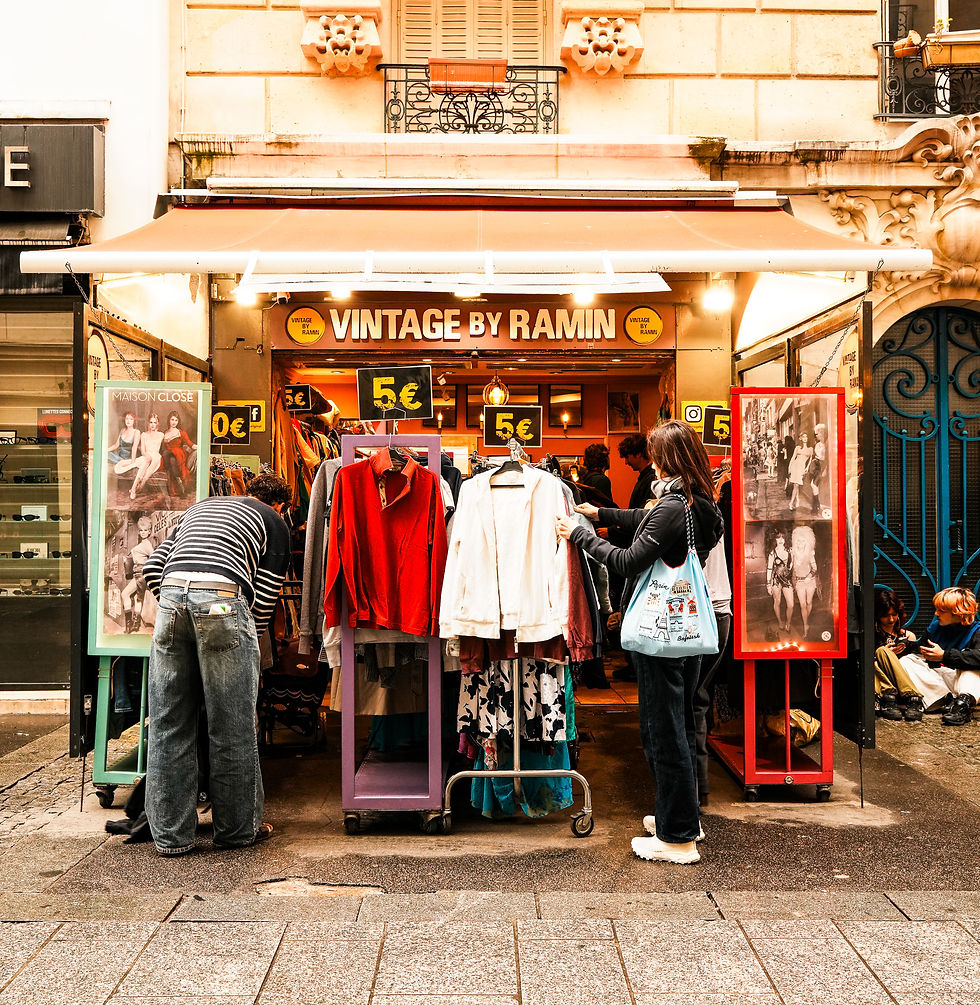
People browsing clothes at a vintage store with a sign "VINTAGE BY RAMIN." Bright colors and 5€ tags on racks. Parisian street vibe.
Vintage by Ramin, somewhere in the Marais. The orange-lit interior spilling out onto the pavement, racks of clothes at five euros, a woman in black browsing, a young man in a striped shirt bent over the lower rail. The red and purple display frames, the black-and-white photography panels on either side. This is the Marais that exists alongside the designer boutiques, doing perfectly well for itself.

The Marais's vintage economy is substantial and worth a dedicated morning if that's your thing. The concentration of affordable secondhand clothing in the streets around Rue de la Verrerie and Rue des Rosiers is notable even by Paris standards.


Woman walks under an umbrella by a restaurant window with neon "BUFFET A VOLONTE NO LIMIT." Gray street sign "RUE DE LA VERRERIE."
Rue de la Verrerie, 4th arrondissement. A neon sign behind glass — "Buffet à Volonté, No Limit" — and a woman in a black raincoat and platform trainers, umbrella up, mid-stride past it. The 4th arrondissement street sign visible at the top right. Paris has a certain genius for placing aspirational signage next to entirely mundane reality.

Rue de la Verrerie in the Rain

Neon "Buffet à Volonté No Limit" with woman and umbrella


Man walks on cobblestone street, holding a plastic bag. Background: beige building, red flowers in windows. Street sign reads "Rue de la Verrerie."
Rue de la Verrerie, same street, same rain. An older man in a grey suit and leather shoes, shopping bag in hand, crossing the wet cobblestones. His reflection in the puddle below. A bistro chair visible to the right. This is the street between the streets — the one that isn't on the itinerary and is exactly where you want to be.


Man sitting in front of vibrant graffiti-covered walls in a city alley. Bright orange and red dominate the scene. Urban, artistic mood.
A passage somewhere in the Marais or Belleville border. Floor-to-ceiling murals across three walls — orange backgrounds, cartoonish figures, tagging, "Museum of Graffiti 305" in bubble letters. A young man in denim, seated on a bollard, looking directly at camera, seemingly as surprised to be there as we were. This is not a curated gallery. It is a working street that happens to also be a canvas.

Street art alley, man seated, Museum of Graffiti]

Paris's street art is unevenly distributed and entirely worth following if you have the time. The concentration around Belleville and the 11th is significant; the Marais edges offer glimpses. There is no single route. The reward is proportional to how much you are willing to walk without a plan.


Person on green scooter in city intersection, wearing a helmet. Eiffel Tower decoration in background. Overcast sky, traffic in motion.
Pont Alexandre III approach. A green Vespa with a white-helmeted rider, and behind him, on top of a tall stone column, one of the four gilded Fames of the bridge — a winged figure on horseback. An e-scooter rider in the middle distance. This is the Paris that exists between the photographs: the functional, moving, slightly overcast reality of a city that contains more gold statuary per square kilometre than almost anywhere on earth.
Person in hoodie and orange pants cycling down a busy city street. Buildings line the road; blue hotel sign visible. Busy, urban vibe.
Paris street toward an arrondissement dome. A cyclist in orange tracksuit trousers heading away from the camera through a street dense with traffic, a classical dome ahead in the distance. Paris is bigger than any one neighbourhood. This is the city reminding you of that.


Person in a brown coat walks past a large, metallic wall with embossed logos. The setting is urban with subdued lighting.
Champs-Élysées. The Louis Vuitton flagship in renovation — its exterior clad in polished silver-grey embossed metal panels, the brand's monogram in relief across the entire facade, reflecting the avenue's trees above. A woman in a camel coat walks along the base of it. She is dwarfed. The building is not subtle. Neither is the brand, which is presumably the point.

The Champs-Élysées gets a bad press from people who feel it has been commercialised, which is a strange complaint to make about a street that has been commercially significant since the Baroque era. It is wide, it is lined with trees, it is full of shops and tourists and delivery bikes, and it is genuinely impressive at scale. You should walk it once. You do not need to walk it twice.


Cars blur past under the Arc de Triomphe in Paris. Evening light, cobblestone street, and a person stands nearby. Historic and dynamic.
Arc de Triomphe, near dusk. A long exposure — cars streak past in blue-white blur, the Arc solid and very still above them. The commissioned reliefs visible on both faces. Napoleon commissioned this in 1806 and died before it was finished. It was completed in 1836. He would have approved of it.

Arc de Triomphe, near dusk


Four days becomes seven and seven is still not enough. The Marais done properly is a full day. The Latin Quarter after dark is a full evening. The Canal Saint-Martin is an afternoon. The Palais Royal gardens are an hour you won't regret. We did all of these partially, gratefully, with one eye on the time. This, I have decided, is not a failure. It is the correct state in which to leave a city: wanting to return.


The Eiffel Tower illuminated against a deep blue night sky, with a beam of light shining from the top. Crowds gather below.
Eiffel Tower, illuminated, from Trocadéro direction, blue hour. The tower gold against the deep blue of the sky after sunset, the searchlight sweeping, the crowd below lit by secondary glow. This is the photograph that everyone who has ever resisted taking this photograph has eventually taken. I offer no apology. It earns it.

Eiffel Tower illuminated, twilight


Paris does one thing that Rome does not, that Florence does not, that none of the other cities on this trip have done in quite the same way. It makes the cliché feel personal. You stand in front of something you have seen a thousand times in photographs, and your first thought is not smaller than I expected or busier than I expected. Your first thought is simply: yes. That's the one.


I'll take that.


Next: We cross into Portugal. Lisbon is waiting — and it has absolutely no interest in competing with Paris. Which is, I suspect, exactly why it works.


Practical Notes

Getting around: Navigo app, Apple Wallet, done. Ten-ride carnet for a measured pace; unlimited pass if you're crossing arrondissements multiple times daily. Research before you land — @lesfrenchiestravel on Instagram is your friend.


Base: Montmartre, 18th arrondissement. Stay within walking distance of Abbesses metro. It is the right call.


Day trip to Giverny: Get-Your-Guide is well managed but expensive. Otherwise, train from Gare Saint-Lazare to Vernon, then bus or taxi to the garden. Book the garden in advance. Budget the full day. Go early.


The Louvre: Two days minimum. We did not do this correctly. Learn from our mistake.


What we'd do differently: More days in the Marais. The Latin Quarter after dark. Canal Saint-Martin on a Sunday. Less time on the Champs-Élysées.


What we got right: Montmartre as home base. Giverny as the escape valve. Taking the rain days seriously instead of fighting them.

Comments


© 2026 after55ed. All Rights Reserved. | Capturing life through the lens.

bottom of page