

Days 16–19: Rome, You Magnificent Problem

37 Days Across Europe · Days 16–19 of 37 · Rome, Italy
Six days in Rome. Three guided day tours. One Pompeii. One Sorrento. One Colosseum. And the quiet, accumulating realisation that Rome is a city you cannot finish, not in a week, not in a month, possibly not in a lifetime.

We arrived from Florence on the Trenitalia Frecciarossa, high-speed, comfortable, deeply civilised. The train deposits you at Roma Termini, which is chaos of an entirely different register from the polished efficiency of Florence's Santa Maria Novella. Rome starts on you immediately.
I had six days here. Going in, I thought six days was generous. Coming out, I realised Rome laughs at six days. Florence rewards the unhurried visitor. Rome defeats them on schedule, then offers to do it again tomorrow. There is simply too much. You have to accept that before you start, or you will spend the entire time feeling behind.
The Spanish Steps and the View Down

The Spanish Steps are busier than you will expect, no matter what you have been told. They are also legitimately, stubbornly beautiful, 135 travertine steps sweeping up to the French church of Trinità dei Monti in a way that manages to feel both monumental and inviting. This is the paradox of Rome's great set pieces: they are never as private as you'd like, and never as spoiled as you'd fear.

The view down from the top is genuinely spectacular and worth the climb independent of anything else. Via Condotti runs perfectly straight away from you, the whole canyon of Roman architecture framing a river of people. It is the kind of shot you can take ten times and still not quite capture.
The Streets Between the Sights

Rome is not as walkable as I expected. There is a version of Rome that people describe, spontaneous, serendipitous, everything a few minutes from everything else, that is partially true in the centro storico but misleads you about the distances involved if you are trying to cover multiple neighbourhoods in a day. The Vatican is not a stroll from the Colosseum. The Pantheon is not a stroll from Trastevere. You will need transport, and the transport is messy, and hence I failed the Angels & Demons walk miserably.
What the streets do offer, when you are between the monuments, is texture.

Trevi Fountain: Go Early, Stay Short

I will say this plainly: the Trevi Fountain is extraordinary. I will also say that you should see it early in the morning, before the tour groups arrive, or in the evening when the light does what it does in this photo. Midday, it is surrounded by a press of people that makes contemplation difficult. This is not a reason to skip it. It is a reason to time it correctly. Apparently 3am in the morning also works. No queues no fee no one. And yes the stories are true, they charge for you to stand next to the fountain, €2.
The scale of the thing surprises even people who think they know what to expect. The fountain is not a centrepiece attached to a building, the building is the fountain. Palazzo Poli serves as the backdrop. Neptune stares outward across the basin. Water moves everywhere. It is pure baroque confidence and it earns every coin thrown into it.
The Vatican, Continued: St Peter's Dome and the Cortile
The Vatican Museum visit (Day 15) had set the tone. The days that followed kept returning to Vatican territory, the dome visible from almost everywhere in the city, a constant gravitational reminder.


Inside the Vatican Museums: The Gallery of Maps


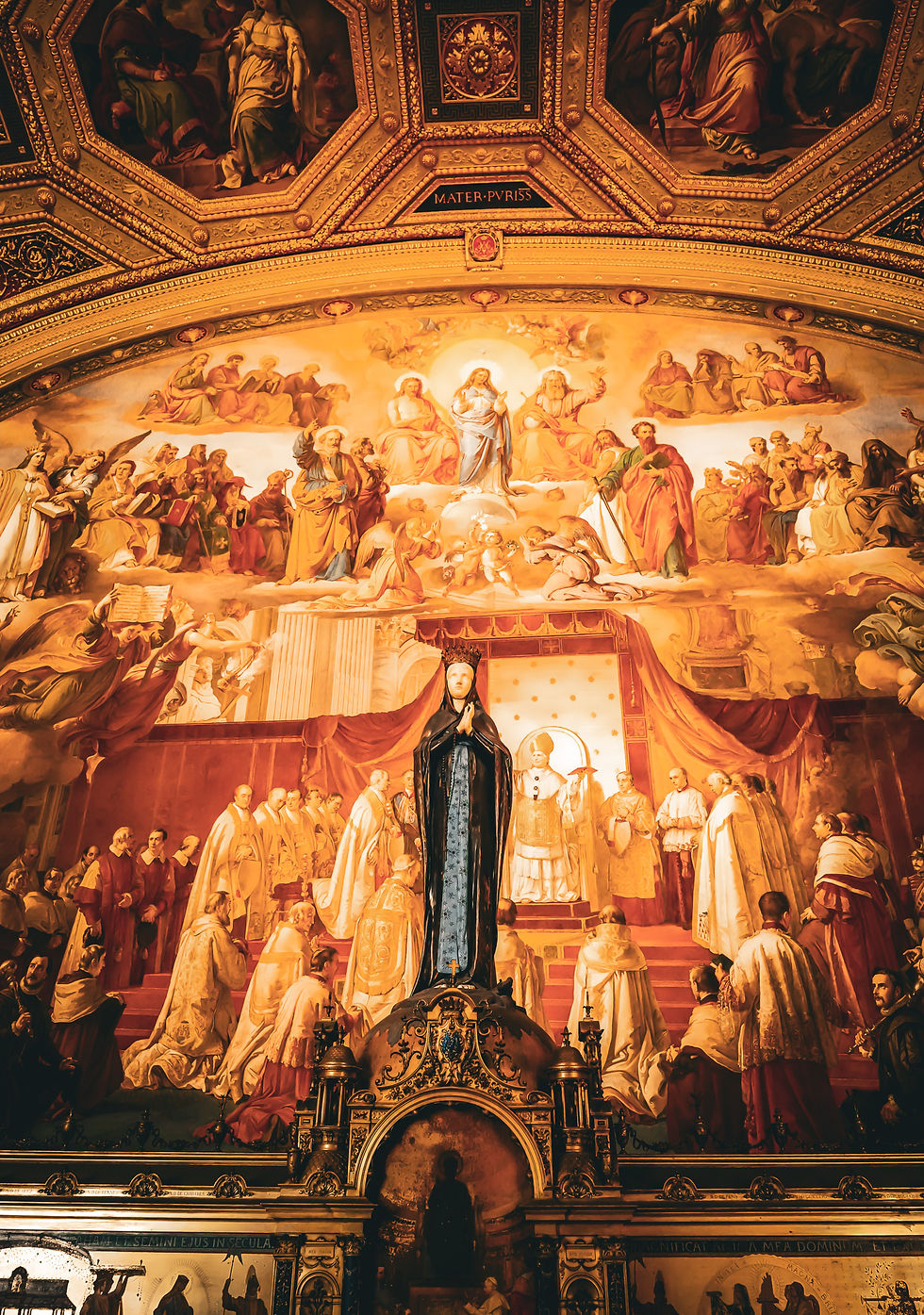
Get Your Guide is not cheap. I will be honest about that. For the Vatican, it is worth every cent, not because the museum experience itself is radically different, but because the queue to get in without a guide is a morning you will not get back. Time in Rome is finite. Buy the time back.
Pompeii, Sorrento, and the Question of Pacing
Here is my honest assessment of the day trips.
The Pompeii and Sorrento day tour was too much. I booked it, as I booked all three of my Get Your Guide tours, with genuine enthusiasm. And both places are worth visiting. But combining them into a single day is a miscalculation I would not repeat.
Pompeii is a mystery in the most literal sense. You walk through streets that were buried by Vesuvius in 79 AD and have been excavating ever since. The plaster casts of the dead. The intact bakeries. The wheel ruts worn into the basalt road surface. The graffiti. It is a place that requires time to sit with, and a rushed group tour gives you motion and commentary when what you actually need is silence and space to think.
Sorrento compounds the problem. It is a genuinely lovely town, perched on cliffs above the Bay of Naples, old-world and fragrant, the kind of place where the limoncello is made locally because the lemons growing on every terrace are extraordinary, and it deserves a day, or at minimum a long afternoon with nowhere to be. The Amalfi Coast stretching out below you. The ferry connections to Capri and Positano. We saw it briefly, through tourist-tour-schedule eyes, which is the worst possible way to see it.
My recommendation: if you are planning Rome and want to do Pompeii and Sorrento, give each its own day. Or give Sorrento two nights and use it as your base for the area. The limoncello deserves more than a rushed sip at a souvenir shop.
The Pantheon: Rome's Best Argument


If I had to choose one place in Rome where the weight of history becomes physically present, it would be the Pantheon. Not the Colosseum, which is spectacular and also a construction site with scaffolding and tourists. Not the Forum, which requires imagination to fill in what is missing. The Pantheon is intact. The concrete dome, the oculus open to the sky, the coffered ceiling, it has been standing, continuously used, for nearly two thousand years. There is no trick to it, no imaginative reconstruction required. You walk in and it is just there, waiting.
Street Life: The Real Rome
Between the monuments and the museums, Rome gives you its streets.


An Irish Pub in Rome, Which Is More Roman Than It Sounds

Every city that sees serious tourist traffic eventually grows an Irish pub. In Rome, this somehow feels appropriate. The Eternal City contains multitudes, including the Krombacher beer mat on the doorstep of a pub that has been hosting the exhausted and the jet-lagged since before any of us showed up.
On Rome, Honestly
Rome is expensive, noticeably more so than Florence, meaningfully more so than Milan's centro storico for day-to-day spending. Restaurants near the major sights charge a premium that reflects the captive audience rather than the quality of the food. Walk two streets further in any direction and the economics improve considerably.
Rome is also not as walkable as you might hope. The major sites are genuinely far apart. The Colosseum to the Vatican is a long walk or a metro ride. Trastevere to the Pantheon requires transport unless you have a lot of time and comfortable shoes. Budget more time between locations than you think you will need, and pace your guided tours. Three guided day tours across six days was too much. I was tired by the end of it, a kind of accumulated saturation that good cities eventually produce in you.
Having said all of that: Rome is among the most compelling cities I have visited in this entire trip. It sits alongside the short list of places, with Milan, Florence, and a few others, where I would willingly extend my stay if the itinerary allowed. There is simply too much here to see in six days. The archaeology alone could occupy a week. The Vatican alone could occupy a week. The street life, the alleyways, the piazzas, the way the light falls on terracotta at five in the afternoon, could occupy a week.
It is a city of intrigue, passion, and mystery. It is also a city of crowds, noise, and aggressive tourist economics. Both things are true. Neither diminishes the other.
I would go back tomorrow.
I departed Rome by Air France to Paris — Charles de Gaulle — which is a sentence that deserves its own post. Paris is next.
Comments